Tel: 01202 721 373

Black Seabream Fisheries

Black seabream (BSB) (Spondyliosoma cantharus) are a species of fish found primarily along the south coast of the UK. BSB were designated as features of the Purbeck Coast Marine Conservation Zone (MCZ) and Southbourne Rough MCZ during the second tranche of MCZ designations in 2019. At the same time, BSB were designated as an 'additional feature' in the Poole Rocks tranche 1 MCZ. BSB are the only designated feature in the Southbourne Rough MCZ, whereas Purbeck Coast and Poole Rocks also protect a range of other habitats and species.

Under Section 154(1) of the Marine & Coastal Access Act 2009 (MaCAA), Southern IFCA must '...seek to ensure that the conservation objectives of any MCZ in the District are furthered...', with Section 154(2) requiring that '...nothing in Section 153(2) is to affect the performance of the duty...'. In developing Southern IFCA's understanding of the brief to inform decision making for BSB management in the three Dorset MCZs, encompassing understanding the route of designation, the relevant Conservation Objectives and exploring early stages of policy development, founded upon the requirements under MaCAA Section 154, the BSB review was split into two parallel streams of work, each having independent policy objectives and legislative underpinnings. 

The Primary Policy Objective, specific to duties under Section 154 of MaCAA considers the managment of high risk fishing activity to manage BSB as a designated feature of MCZs and, in satisfying this objective by furthering the Conservation Objectives through application of existing statutory measures, which included an update to the Bottom Towed Fishing Gear Byelaw, the Secondary Policy Objective, considers additional management options for lower risk fishing activities to improve understandings of BSB across the Dorset MCZs, underpinned by Section 153 of MaCAA and working alongside the Dorset Community.

  • Primary Policy Objective: Managing BSB as a designated feature of Marine Conservation Zones
  • Secondary Policy Objective: Improve understandings of BSB across the Dorset Marine Conservation Zones

The delivery of the Secondary Policy Objective is through the introduction of the Black Seabream Co-Developed Principles, developed collectively between Southern IFCA and the Dorset Community.


The sections below provide more detail on the management relevant to black seabream within the three Dorset MCZs, with a section on management which manages BSB as a designated feature of MCZs and a section on the Black Seabream Co-Developed Principles. There is also a section linking the Process Documents which collectively provide clarity of the process and intention that underpinned the management approach and explain the route to achieving the Policy Objectives, as well as Southern IFCA's intentions for the implementation and monitoring of management tools, and future review of BSB fisheries in the three Dorset MCZs.

   Managing Black Seabream as a Designated Feature of MCZs

   Black Seabream Co-Developed Principles

  Black Seabream Management Package Process Documents


Managing Black Seabream as a Designated Feature of MCZs

The MCZ Assessments underpinning the management of BSB in the Purbeck Coast MCZ, Poole Rocks MCZ and Southbourne Rough MCZ concluded that appropriate mitigative measures already in place or developed as part of this process provide a combination of spatial and technical statutory mechanisms, including the update to the BTFG Byelaw 2023, which are collectively furthering the Conservation Objectives relevant to BSB. These measurse are also providing protection to BSB beyond the three MCZs collective footprint, at a temporal scale beyond that of the breeding season. As such, these statutory measures are providing protection to BSB nesting sites and populations at a level which exceeds the scope of the Conservation Objectives and satisfy the Primary Policy Objective for the development of management for BSB.

The statutory measures which manage black seabream as a designated feature of the thre MCZs are:

  • Bottom Towed Fishing Gear Byelaw 2023 - this byelaw eliminates BTFG activity across the entirety of Poole Rocks MCZ (whole site) and Southbourne Rough (whole site) and via a BTFG spatial closure across 93% of the Purbeck Coast MCZ, thus removing the highest risk fishing activity almost in its entirety across the three Dorset MCZs.
  • Minimum Conservation Reference Size Byelaw - the enforcement of a minimum conservation reference size (MCRS) of 23cm is delivered at a District wide level, applicable to all commercial and recreational users as well as the wider supply chain.
  • Spatial Restrictions via an Exclusion Zone - this applies in the Purbeck Coast MCZ, which equates to quantifiable closures for c.32% of the breeding season, across c.33% of the MCZ (which can be extended to c.54%), as enforced by the Ministry of Defence, applied to all gear types (commercial and recreational) via closures applicable to all sea users.

In combination, these measures are furthering the Conservation Objectives for BSB across the Purbeck Coast MCZ, Poole Rocks MCZ and Southbourne Rough MCZ and accordingly will not hinder the achievement of the Conservation Objectives, thus satisfying the Primary Policy Objective in accordance with Section 154 legal duties under MaCAA.

Back to top

Black Seabream Co-Developed Principles

The Co-Developed Principles, delivered under the Secondary Policy Objective , in line with Southern IFCA's duties under Section 153 of the MaCAA, complement the existing statutory protections as well as seeking to improve understandings of black seabream and support long-term sustainability in relevant fisheries. 

The Co-Developed Principles were developed with the Dorset Community, drawing on expert views and contextual information on relevant fisheries and their cultural, community and socio-economic importance through a staged engagement and feedback process, to ensure that a proportionate and adaptive approach can be taken which improves understandings of this data-poor species whilst supporting sustainable fishing opportunities and continues to strengthen partnership working with the community. 

The Co-Developed Principles are voluntary, and will be in place from 1st April 2026, Southern IFCA encourage participation from all fishing sectors to ensure the continued sustainability of black seabream fisheries. 

Southern IFCA will continue to work with the Dorset Community in the implementation and monitoring of the Co-Developed Principles. 

Please click on the links below to view:


Information materials will be distributed to relevant locations and organisations to support the engagement and provision of information on the Co-Developed Principles. If you would like to receive a copy of any of the information materials for the Co-Developed Principles please email enquiries@southern-ifca.gov.uk.


There are also specific sections provided below giving more detail on:
Please share this information with your colleagues, club members, friends and family to help promote engagement and education on the new measures. Southern IFCA will be engaging across the community during the breeding season and we welcome your feedback on the Co-Developed Principles and how they are working within the fisheries. 

Following the end of each breeding season a review will be carried out considering all relevant feedback, input and evidence that has been gathered during that year. After 2030, Southern IFCA will explore a wider review of management measures to ensure that black seabream fisheries can continue to operate sustainably within the Dorset MCZs.
 

Co-Developed Principles

Who are the Co-Developed Principles For?

The Co-Developed Principles are for all fishers who fish for black seabream:

  • Commercial fishers
  • Recreational fishers
  • Charter fishing vessels

When do the Co-Developed Principles Apply?

For the identified breeding season for black seabream in the three Dorset MCZs: 1st April to 31st July each year

The data collection programme will run year-round


Where do the Co-Developed Principles Apply?

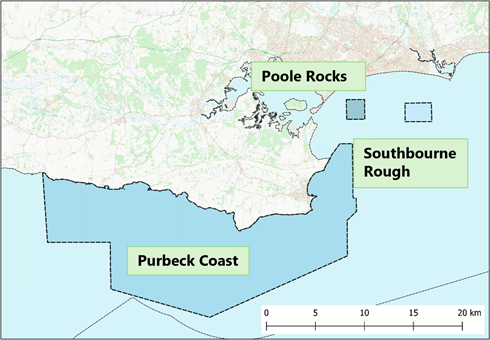
The Co-Developed Principles apply to three MCZs in Dorset:

  • Purbeck Coast MCZ
  • Poole Rocks MCZ
  • Southbourne Rough MCZ


A Google Maps Tool is available to help the community locate the MCZs when out fishing, please click here for more information


Co-Developed Principle: Guidance

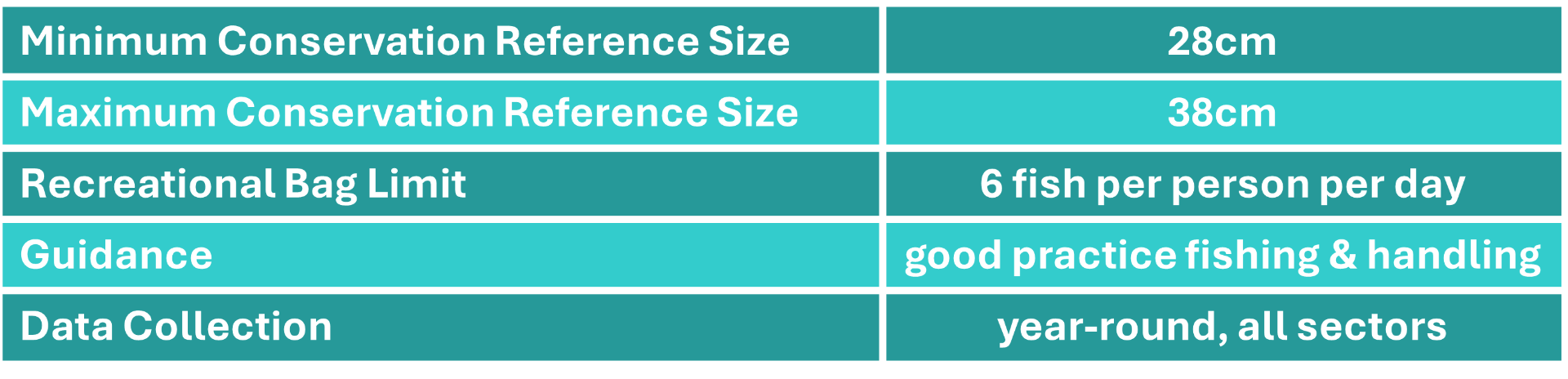
Under the Guidance Co-Developed Principle, fishery guidance has been produced covering recommended equipment, handling techniques and care & ethics for BSB fisheries. The guidance measures are designed to improve survivability through minimal handling time and air exposure. By supporting breeding success and ensuring released fish have the best chance of survival, these measures help maintain healthy population levels and secure the futrue of the fishery for both biolgoical and economic purposes. Consistent handling practices will also support improved data for the fisheries over time, helping to deepen understandings of BSB populations and the effectiveness of management. 

Please click here to view a copy of the Southern IFCA Black Seabream Fishery Guidance


Co-Developed Principle: Data Collection

BSB populations and associated fisheries are data-poor. The Data Collection Co-Developed Principle will enable data to be collected at the scale of the three Dorset MCZs to support wider external research and create an evidence base to help inform ongoing sustainble management. 

Data will be collected year-round to help inform understandings of black seabream both within and outside of the breeding season. Data from the breeding season will be analysed as part of annual reviews of the Co-Developed Principles with additional data collected outside of the breeding season feeding into this process as well. 

All data collected will be anonymised, with sensitive data protected, and will be processed and held in accordance with General Data Protection Regulations (GDPR). 

Please click here to view our information leaflet on the Data Collection Programme
 

What Data is Needed?

We are seeking data from:

  • Commercial fishers (net, rod & line)
  • Recreational fishers (rod & line)
  • Charter vessels (rod & line)

Data collection is needed for any fishing for black seabream within the three Dorset MCZS: 
  • Purbeck Coast
  • Poole Rocks
  • Southbourne Rough

A Google Maps Tool is available to help the community locate the MCZs when out fishing, please click here for more information


Through the Data Collection Programme, data is being sought to help increase understandings of:

  • Fishing activity, including gear & methods, number of fishers, locations & length of trip
  • Black seabream as a target or bycatch species, number of fish caught & retained, fish caught over the MaxCRS or under MCRS and landings data
  • Seasonality of fishing activity and black seabream populations, within and outside of the breeding season
  • Information on occurrence of breeding males or females


How can you provide data?

Southern IFCA want to ensure that the Dorset Community are supported in providing data to the Data Collection Programme. These are three data forms available, one for each fishing sector.

Data can be submitted in the following ways:
 

1. Using paper forms which can be printed from the Southern IFCA website or requested from the Southern IFCA Office - paper forms can be posted or emailed to Southern IFCA or you can send us a photo of your completed form

Printable copies of the paper forms can be accessed via the links below:
Please submit your data forms, if using printed or emailed forms or photographs, to:

Email: enquiries@southern-ifca.gov.uk 

Post: Unit 3 Holes Bay Park, Sterte Avenue West, Poole, Dorset, BH15 2AA


2. Using an online form that can be accessed using a laptop, tablet or mobile phone - forms submitted online will be sent directly to Southern IFCA

The online forms can be accessed via the links below:


Back to top

The Dorset Community

Working with the Dorset Community to create the Co-Developed Principles, Southern IFCA was able to draw on expert views and contextual information on relevant fisheries and their cultural, community and socio-economic importance to ensure that a proportionate and adaptive approach could be taken which improves understandings of black seabream as a data-poor species whilst supporting sustainable fishing opportunities, complementing statutory protections, and continuing to strengthen partnership working with the community. 

The Authority extends its thanks to the community, including representatives from the commercial, recreational and charter fishing sectors, for their engagement and dedication to the co-development process. The expert knowledge provided at various stages was instrumental in the development of the BSB Management Package, particulalry in shaping the Co-Developed Principles. Southern IFCA looks forward to continuing to work with the community through 2026 and beyond to support and promote sustainable black seabream fisheries in Dorset.


Back to top


Black Seabream Management Package Process Documents

There are three Process Documents which provide detail of management intentions as part of the Black Seabream Management Package. These documents collectively seek to provide clarity of intention and process which has underpinned the development of the Management Package, giving a transparent and comprehensive overview of how management tools ensure that Southern IFCA is able to meet its legal duties under the MaCAA for the two defined Policy Objectives for management development.

Process Document 1 - Delivering Policy Objectives
Providing detail of Southern IFCA's delivery under each Policy Objective, providing the scope, legislative underpinning under MaCAA, focus areas/drivers/objectives and management tools. For each Policy Objective it is outlined how the Authority has satisfied the Policy Objective in delivering managment. 


Process Document 2 - Decision Making & Roadmap
Providing detail on understanding the brief to inform decision making, the process followed by the Authority in developing the BSB Management Package and how this led to the development of management tools under each Policy Objective and how each Policy Objective is therefore satisfied.


Process Document 3 - Management Tools, Application & Review
Outlining the detail of management tools which support BSB fisheries within the three Dorset MCZs with detail on the scope of management tools and the provisions each tool provides, defined by the relevant Policy Objectives. Detail is also given on monitoring compliance, data collection and the process by which a review will be used to ensure an adaptive management approach.


To support the MCZ Assessments for the three Dorset MCZs and to inform and support understandings of BSB biology, ecology and fisheries supporting documents were developed:

Black Seabream Literature Review
This document uses the best available evidence, namely peer reviewed papers and reports, with a focus on the most relevant sources in relation to the location and date publisehd, to ensure that sound scientific evidence is used to inform assessments of BSB in relation to fishing activities.


Black Seabream Site Specific Evidence Packages
This document provides site specific evidence for each of the three Dorset MCZs, including feature location & extent, levels of fishing activity and additional data sources on landings, which have been used as one source of best available evidence to inform the MCZ Assessments for each site for relevant fishing activity. 


The Process Documents and Supporting Documents are designed to be read in conjunction with one another, providing detail of how, in satisfying both Policy Objectives, via the application of dual legislative function, and in unification of the resulting management solutions applicable to each, Southern IFCA, with the support of the Dorset Community, are collectively championing a proportionate management approach which fundamentally seeks to improve understandings of BSB populations, information which is vital in current and future approaches to sustaining BSB fisheries across the three Dorset MCZs and beyond. The approach allows ongoing management to be based on improved evidence as supported and informed via ongoing co-development with the community, the holistic approach providing not only a solution to the primary legislative driver (MaCAA Section 154) but also facilitates hollistic approaches which remain true to the wider functions of the Southern IFCA, as specified under MaCAA Section 153.

Back to top

© Copyright 2026 Southern IFCAWeb Design By Toolkit Websites